
Why Most Startups Fail After Product-Market Fit: The Hidden Execution Gap That Kills Growth
Achieving product-market fit feels like reaching the summit, but for many startups, it's just the beginning of a more treacherous journey. Research shows that 78% of startups fail even after finding product-market fit, a statistic that challenges the common belief that this milestone guarantees long-term success. The reality is that the transition from early validation to sustainable growth introduces a new set of complex challenges that catch most founders unprepared.
Most startups fail after product-market fit because they struggle with scaling operations, maintaining innovation, adapting to competitive pressures, and evolving from founder-led to structured growth models. These failures rarely stem from the product itself. Instead, they result from operational breakdowns, leadership gaps, and an inability to sustain the very qualities that made the startup successful in the first place.
Understanding why this happens—and more importantly, how to prevent it—can mean the difference between becoming a cautionary tale and building a lasting company. The patterns are clear, the risks are identifiable, and the solutions are within reach for founders who approach this phase with the right strategies and mindset.

Key Takeaways
Achieving product-market fit does not guarantee long-term success, as 78% of startups fail during the scaling phase
Post-product-market-fit failures typically result from operational challenges, competitive pressures, and inability to transition from founder-led to structured growth
Preventing failure requires strategic leadership, continuous innovation, operational excellence, and adapting to market dynamics whilst maintaining core strengths
Product-market fit represents the degree to which your product satisfies strong market demand. Many founders misunderstand what it truly means and mistake early traction for genuine fit.
Defining Product-Market Fit
Product-market fit occurs when you've built a product that solves a meaningful problem for a clearly defined market that's willing to pay for your solution. It's not about having a clever idea or securing funding. It's about creating something people actively want and need.
The concept centres on three elements working together. First, you need a target customer segment with a genuine problem. Second, your product must solve that problem better than existing alternatives. Third, customers must demonstrate their satisfaction through retention, engagement, and word-of-mouth growth.
Marc Andreessen described it as being in a market that can be satisfied with your product. You'll know you've achieved it when customers start pulling your product from you rather than you pushing it onto them. Sales cycles shorten, retention rates climb, and organic growth begins to compound.
Recognising the Signs of Fit
Strong retention rates serve as the primary indicator of product-market fit. If customers keep using your product week after week, you're solving a real problem. Look for retention curves that flatten after the initial drop-off period.
Organic growth through referrals signals genuine fit. Your users should actively recommend your product without prompting. Track your Net Promoter Score and monitor how many customers would feel "very disappointed" if they could no longer use your product—the benchmark is 40% or higher.
Other signs include shortened sales cycles, increased customer lifetime value, and growing demand that strains your resources. You'll notice customers using your product in ways you hadn't anticipated. Support queries shift from "how does this work?" to "can you add this feature?"
Common Misconceptions About Product-Market Fit
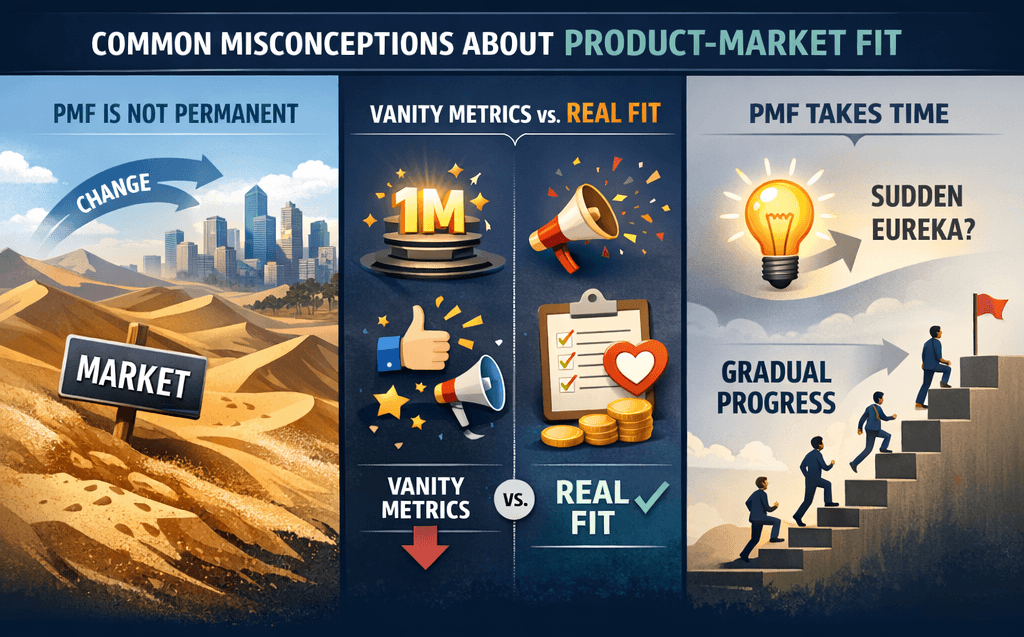
Product-market fit is not a permanent state. Markets evolve, competitors emerge, and customer needs shift. What worked brilliantly in 2024 might become irrelevant by 2026. You must continuously validate that your product still meets market demands.
Many founders mistake vanity metrics for product-market fit. High download numbers, press coverage, or initial sign-ups don't indicate fit. These metrics can mislead you into thinking you've succeeded when you haven't built anything sustainable.
Another misconception is that product-market fit happens suddenly. It's typically gradual, emerging through iteration and refinement based on customer feedback. You won't wake up one day having achieved it. Most successful startups go through multiple pivots before finding genuine fit, and some never achieve it despite raising millions in funding.
The Myth of Guaranteed Success After Product-Market Fit
Achieving product-market fit creates a false sense of security for many founders. Research shows that 78% of startups fail even after reaching this milestone, proving that finding early traction doesn't guarantee long-term survival.
Why Product-Market Fit Is Not the Finish Line
Product-market fit validates that your solution solves a real problem for a specific customer segment. It doesn't, however, confirm that you can scale operations, retain customers, or defend against competitors.
Many founders treat this milestone as permission to accelerate growth without addressing fundamental operational gaps. Your team structure that worked for 10 customers often breaks down at 100 or 1,000. The manual processes you used to onboard early adopters become bottlenecks that stall expansion.
You also face new challenges that didn't exist in the early stages. Customer acquisition costs typically rise as you move beyond early adopters. Your initial product advantages may erode as competitors replicate your features. Cash flow management becomes critical as you attempt to scale before revenue catches up with expenses.
The Role of Market Dynamics
Markets shift continuously, and your product-market fit exists within specific conditions. Customer preferences evolve, new technologies emerge, and regulatory changes can reshape entire industries within months.
A competitor entering your space with greater resources can rapidly erode your position. Larger companies often copy successful startup models once they validate market demand, then outspend you on marketing and sales.
Economic conditions directly impact your growth trajectory. During downturns, customers reduce spending, extend sales cycles, and demand more value. Your pricing model that worked in a strong economy may become unsustainable when budgets tighten. You must continuously monitor these external factors and adapt your strategy accordingly, rather than assuming your initial success will persist indefinitely.
Primary Reasons Startups Fail After Achieving Product-Market Fit
Achieving product-market fit doesn't guarantee long-term success. Startups often stumble due to aggressive scaling, ignoring evolving customer needs, or internal team dysfunction that undermines their initial momentum.
Scaling Too Quickly
Rapid expansion after finding product-market fit can deplete your resources faster than revenue grows. Many founders mistake early traction for permission to hire aggressively, expand to new markets, or invest heavily in infrastructure before validating sustainable unit economics.
Your operational complexity multiplies with each new hire and market. What worked with a team of 10 people often breaks down at 50, requiring new processes, management layers, and communication systems. Without proper foundations, quality deteriorates and customer satisfaction drops.
Critical scaling mistakes include:
Expanding to new customer segments before dominating your initial market
Hiring ahead of revenue rather than in response to proven demand
Increasing marketing spend without confirmed customer acquisition payback periods
Opening new offices or geographic markets prematurely
You need systems that scale alongside headcount. Cash burn accelerates when your team grows faster than your ability to onboard, train, and integrate new members effectively.

Neglecting Customer Feedback
Your initial product-market fit reflects a specific moment in time. Customer needs evolve, competitors emerge, and market conditions shift. Startups that stop listening to customers after early success often watch their advantage erode.
You might become insulated from users as your organisation grows. Founders who previously spoke directly with customers delegate these conversations, losing critical insights. Product decisions start reflecting internal opinions rather than market reality.
Your early adopters may have different needs than mainstream customers. Failing to adapt your product and messaging as you move beyond enthusiasts leads to stalled growth and declining retention rates.
Leadership and Team Misalignment
Early teams often bond through shared struggle and informal communication. As you scale, misalignment between executives, managers, and individual contributors creates friction that stalls progress. Different visions for the company's direction lead to conflicting priorities and wasted effort.
Your founding team's skills may not match what the business needs at scale. Technical founders who excelled at building the initial product might struggle with operational management, sales leadership, or strategic planning.
Cultural deterioration accelerates when hiring happens too quickly. New team members lack context about your company's values and decision-making principles. Without intentional culture preservation, your organisation fractures into competing factions with different objectives.
Operational Challenges Facing Post-Product-Market Fit Startups
Startups that validate market demand often stumble when scaling because they lack the operational infrastructure to support growth. Process weaknesses, misallocated resources, and poor financial controls create bottlenecks that prevent companies from capitalising on their initial traction.
Weak Organisational Processes
Your startup likely operated with informal workflows during the product-market fit phase, where small teams made quick decisions without documentation. This approach breaks down rapidly when you add headcount and complexity. Communication gaps emerge between departments, tasks get duplicated, and accountability becomes unclear.
Without standardised processes for product development, customer onboarding, and quality assurance, you'll experience inconsistent output and slower execution. Your team spends time resolving confusion rather than delivering value. Critical knowledge remains locked in individual team members' heads rather than captured in systems.
You need to document core workflows, establish clear decision-making hierarchies, and implement project management frameworks that scale. Many founders resist this structure, viewing it as bureaucracy. However, repeatable processes actually increase speed by eliminating constant problem-solving of the same issues.
Resource Allocation Errors
You face competing demands for limited capital, personnel, and time after achieving product-market fit. Common mistakes include hiring too quickly without defined roles, spreading engineering resources across too many features, or investing heavily in marketing before operational capacity exists to service new customers.
Your technical debt accumulates when you prioritise new feature development over infrastructure improvements. Customer success teams become overwhelmed as acquisition outpaces your ability to support users effectively. Sales targets push volume whilst operations struggle to fulfil orders or deliver services reliably.
Strategic resource allocation requires you to balance growth initiatives with operational strengthening. You must assess whether additional investment in systems, tooling, or team capabilities delivers better returns than purely growth-focused spending.
Inadequate Financial Oversight
Your financial management requirements shift dramatically as revenue grows and operations become more complex. Basic bookkeeping no longer suffices when you need detailed unit economics, cash flow forecasting, and departmental budget tracking.
Many founders lack visibility into true customer acquisition costs, lifetime value calculations, or burn rate projections beyond basic cash balance monitoring. You discover spending inefficiencies months late or fail to identify unprofitable customer segments draining resources. Without proper financial controls, authorisation processes, or spending limits, costs spiral unexpectedly.
You require proper accounting systems, regular financial reporting, and clear metrics that inform strategic decisions. This includes monthly reviews of key performance indicators, variance analysis against budgets, and scenario planning for different growth trajectories.
Market and Competitive Pressures
Achieving product-market fit doesn't guarantee immunity from external forces. Startups face intensifying competition, saturated markets, and evolving customer expectations that can erode their hard-won position.
Increased Competition
Your success signals opportunity to others. Competitors emerge quickly once you've validated demand, often with better resources or more efficient execution. Well-funded rivals can replicate your features whilst undercutting prices or offering superior customer service.
Established companies pose a particular threat. They enter validated markets with existing distribution channels, brand recognition, and capital reserves that dwarf startup budgets. Your initial advantage from finding product-market fit diminishes as competitors iterate and learn from your approach.
New entrants also innovate beyond your solution. They observe your limitations and build products that address gaps you haven't filled. This creates pressure to evolve continuously rather than rest on early achievements.
Key competitive challenges include:
Direct competitors copying core features
Adjacent players expanding into your market
Platform companies bundling similar functionality
International competitors entering your region

Market Saturation
Markets fill faster than most founders anticipate. Your total addressable market shrinks as competitors claim customers and early adopters reach capacity. Acquisition costs rise whilst conversion rates decline.
Customer expectations escalate simultaneously. What differentiated your product initially becomes table stakes. You need additional features, integrations, and support levels to compete for the remaining market share.
Growth rates naturally slow as you exhaust low-hanging opportunities. The strategies that worked for your first thousand customers rarely scale to the next ten thousand without significant modification.
Shifting Consumer Preferences
Customer needs evolve independently of your product roadmap. Technological advances, regulatory changes, and cultural shifts alter what users value. Your product-market fit today may not align with tomorrow's requirements.
Behaviour patterns change as markets mature. Early adopters tolerate friction that mainstream users reject. Your onboarding process, pricing structure, and feature set must adapt to different audience segments.
External disruptions accelerate preference shifts. Economic downturns, new platforms, and societal changes force customers to reprioritise spending and reassess solutions. Startups that fail to monitor and respond to these signals lose relevance even with strong initial fit.
Product and Innovation Stagnation
After achieving product-market fit, many startups mistakenly treat their product as finished rather than as a foundation for continuous improvement. Markets evolve, competitors advance, and customer expectations shift, making ongoing innovation essential for survival.
Failure to Iterate the Product
Your product requires constant refinement based on user feedback and changing market conditions. Startups that stop iterating after finding initial success quickly fall behind competitors who continue improving their offerings.
Customer needs evolve over time, and the features that initially attracted users may become table stakes within months. You must establish feedback loops through user interviews, analytics, and support tickets to identify what requires enhancement. This data should directly inform your product roadmap.
Key iteration priorities include:
Performance optimisation – Speed, reliability, and scalability improvements
User experience refinement – Reducing friction points and streamlining workflows
Feature development – Adding capabilities that address emerging user needs
Technical debt reduction – Maintaining code quality and system architecture
Successful companies allocate dedicated resources to product iteration rather than exclusively focusing on new customer acquisition. You cannot sustain growth with a stagnant product, regardless of how well it initially performed.
Overlooking Emerging Trends
Market dynamics shift rapidly, and failing to monitor technological advances and industry changes leaves you vulnerable to disruption. Your competitors are scanning the horizon for opportunities whilst you risk becoming obsolete.
You must actively track developments in your industry through research, competitor analysis, and participation in professional communities. This includes monitoring new technologies, regulatory changes, and shifting customer preferences that could impact your market position.
Pay attention to adjacent markets where innovations might eventually affect your space. Social media platforms, for example, initially seemed irrelevant to many industries before becoming critical marketing channels.
Establish a systematic approach to trend analysis rather than relying on ad-hoc observations. Quarterly reviews of market intelligence, customer behaviour patterns, and technological developments help you identify threats and opportunities before they become critical. Allocate time for experimentation with emerging technologies that could enhance your product or business model.
Scaling and Growth Pitfalls
Many startups that achieve product-market fit stumble during the transition to scaled operations. Growth becomes unsustainable when companies expand too quickly or fail to establish repeatable systems for customer acquisition.
Overexpansion
Premature scaling represents one of the most common reasons startups fail after finding initial traction. You might be tempted to rapidly increase headcount, open new markets, or diversify your product line when revenue starts flowing. However, expanding before establishing a repeatable and profitable customer acquisition model drains cash reserves without generating proportional returns.
The warning signs of overexpansion include:
Hiring specialists before you understand the role requirements
Entering new geographic markets without validating demand
Building features for hypothetical customers rather than existing ones
Increasing marketing spend without clear unit economics
You need to ensure your operational infrastructure can support growth before accelerating it. This means documenting processes, establishing clear metrics for success, and confirming that your current systems work efficiently. Companies that scale successfully typically maintain controlled growth rates whilst continuously refining their core operations.
Ineffective Go-to-Market Strategies
Product-market fit proves customers want your solution, but it doesn't automatically translate into consistent revenue growth. You must develop a structured approach to customer acquisition that extends beyond founder-led sales or early adopter networks.
Without a scalable go-to-market motion, your sales cycles remain unpredictable and costly. Your team needs clear playbooks that new hires can follow, defined customer segments with specific messaging, and reliable channels that consistently deliver qualified leads. Many startups fail because they rely on tactics that worked for their first 50 customers but can't acquire the next 500.
Test your go-to-market strategy by measuring customer acquisition cost, conversion rates at each funnel stage, and the time required to close deals. If these metrics vary wildly or depend entirely on founder involvement, you haven't yet built a repeatable system.
How to Prevent Post-Product-Market Fit Failure
Success after achieving product-market fit requires deliberate action across three critical areas: fostering a culture that can weather growth challenges, maintaining product excellence through systematic improvement, and establishing processes that scale with demand.
Building Resilient Company Culture
Your company culture determines whether your team can handle the pressures of scaling. As you grow beyond the founding team, you need clear values that guide decision-making at every level.
Document your core principles explicitly. Write down what behaviours you reward, how decisions get made, and what trade-offs matter most. This clarity prevents cultural dilution as headcount increases.
Key cultural elements to establish early:
Communication norms – Set expectations for how teams share information and resolve conflicts
Decision rights – Define who can make which decisions without approval
Hiring criteria – Specify both skills and cultural attributes required for new team members
Feedback mechanisms – Create regular channels for honest communication up and down
Transition from founder-led to distributed leadership gradually. Identify high-potential employees and give them meaningful ownership over specific areas. This delegation builds organisational resilience whilst allowing you to focus on strategic priorities rather than operational details.
Continuous Product Improvement
Product-market fit is not a permanent state. Markets evolve, competitors emerge, and customer expectations shift constantly.
Establish quantitative metrics that indicate when fit begins degrading. Track usage frequency, feature adoption, customer retention cohorts, and Net Promoter Score monthly. Set thresholds that trigger investigation when metrics decline beyond normal variation.
Create a structured feedback loop with customers. Schedule quarterly interviews with both active users and those who've reduced usage. Ask specific questions about unmet needs, frustrations, and alternative solutions they're considering.
Allocate engineering resources deliberately between new features and technical debt. A common ratio is 70% new development, 20% improvements to existing features, and 10% infrastructure work. Adjust based on your product's maturity and technical state.
Implementing Scalable Processes
Manual processes that worked for 100 customers break at 1,000. You need systems that handle increased volume without proportional headcount growth.
Map your critical workflows first. Document each step in customer onboarding, support ticket resolution, and product deployment. Identify bottlenecks where work queues up or requires founder intervention.
Automate repetitive tasks before hiring more people. Customer onboarding emails, data validation, report generation, and status updates can often be systematised. This frees your team for work requiring human judgement.
Standardise decision-making for recurring situations. Create playbooks that specify how to handle common customer requests, pricing negotiations, or technical incidents. This reduces decision fatigue and ensures consistent outcomes.
Invest in your data infrastructure early. You need reliable metrics on customer behaviour, financial performance, and operational efficiency. Poor data quality leads to uninformed decisions during critical scaling moments.
Strategic Leadership for Sustained Success
Founders must transition from product creators to organisational architects who align teams around measurable goals whilst making decisions grounded in evidence rather than intuition.
Visionary Leadership and Alignment
Your leadership approach needs to shift dramatically once you've achieved product-market fit. The skills that helped you build your initial product—hands-on involvement, rapid pivoting, intuitive decision-making—can become liabilities during scale-up.
You need to establish clear organisational alignment by communicating a concrete vision that extends beyond product features. This means defining specific growth targets, market positioning, and operational priorities that every department can translate into daily actions. When your engineering team understands how their work connects to customer acquisition goals, and your sales team grasps the technical limitations affecting delivery timelines, you create the cross-functional coordination required for sustainable growth.
Key alignment practices include:
Weekly leadership meetings focused on interdependencies between teams
Quarterly objectives that cascade from company goals to individual contributors
Transparent communication about strategic trade-offs and resource allocation
Your role becomes less about solving individual problems and more about building systems that solve problems consistently. This requires delegating authority whilst maintaining accountability through structured reporting and regular strategic reviews.
Leveraging Data-Driven Decision-Making
Post-PMF growth requires replacing founder instinct with systematic analysis. You need to establish metrics frameworks that track leading indicators of success, not just lagging outcomes like revenue.
Implement cohort analysis to understand customer behaviour patterns over time. Track activation rates, feature adoption, and retention curves to identify where users extract value. Monitor unit economics including customer acquisition costs, lifetime value, and payback periods to ensure your growth model remains viable at scale.
Essential metrics to monitor:
Monthly recurring revenue growth rate and churn by customer segment
Sales cycle length and conversion rates at each funnel stage
Team productivity metrics like feature velocity and deployment frequency
Create dashboards that surface these insights to relevant stakeholders without overwhelming them. Your customer success team needs different data than your product team. You should establish regular data review sessions where teams analyse trends and adjust tactics based on evidence, not opinions.
Conclusion
Product-market fit represents a significant milestone, but it marks the beginning of new challenges rather than the end of your startup journey. The period immediately following this achievement requires sustained focus on three critical areas: operational scaling, talent acquisition, and strategic planning.
Your ability to maintain momentum depends on building systems that support growth without compromising the core value proposition that attracted your initial customers. Many founders mistakenly believe that achieving product-market fit guarantees success, yet data shows that 78% of startups still fail after reaching this stage.
The key difference between startups that thrive and those that falter lies in their preparation for post-fit challenges. You need to:
Establish scalable processes before demand outpaces capacity
Build a leadership team with experience in your next growth phase
Maintain close relationships with customers as your organisation expands
Monitor unit economics and burn rate with increased rigour
Create a culture that supports rapid scaling without losing company values
Your success requires balancing growth ambitions with operational realities. Markets evolve, customer expectations shift, and competitors emerge regardless of your early achievements.
Focus on building sustainable systems whilst preserving the agility that helped you reach product-market fit. The startups that navigate this phase successfully treat it as an ongoing process of adaptation rather than a static achievement to protect.
Frequently Asked Questions
Startups face distinct challenges after achieving product-market fit, from scaling operations and managing cash flow to adapting to market shifts and maintaining team cohesion. These questions address the critical factors that determine whether a startup thrives or fails during this pivotal growth phase.
Running out of cash remains the primary killer of startups even after they've found product-market fit. You may have customers who love your product, but if you scale too quickly without sustainable unit economics, you'll burn through capital faster than you can generate revenue.
Poor execution during the scaling phase causes many startups to collapse under their own growth. Your systems and processes that worked for 10 customers won't necessarily support 1,000 customers, and failing to build the right infrastructure leads to operational breakdowns.
Losing focus on your core value proposition whilst chasing new opportunities dilutes your competitive advantage. You might be tempted to expand into adjacent markets or add features that don't align with what made you successful initially.
Premature scaling destroys startups that hire aggressively, expand to new markets, or invest heavily in marketing before establishing repeatable and profitable customer acquisition channels. You'll find yourself with high fixed costs but inconsistent revenue growth.
Ignoring competition after initial success leaves you vulnerable to market disruption. Your competitors won't stand still, and assuming your product-market fit is permanent without continuous innovation puts you at risk of becoming obsolete.
Building features nobody asked for instead of listening to customer feedback creates feature bloat and technical debt. You might think you know what customers need next, but assumptions replace the customer evidence that got you to product-market fit in the first place.
Maintaining close relationships with your customers ensures you understand their evolving needs and spot early warning signs when satisfaction drops.
Regular customer conversations reveal whether your product still solves their most pressing problems or if competitors are gaining ground.
Investing in retention metrics rather than focusing solely on acquisition prevents the leaky bucket problem where new customers replace churned ones instead of adding to your base. You need to track cohort retention, net revenue retention, and customer lifetime value to understand if your growth is sustainable.
Building scalable systems before you desperately need them gives you breathing room during rapid growth. Your technology infrastructure, customer support processes, and internal operations should be designed to handle 10 times your current volume.
Misunderstanding unit economics leads you to scale unprofitable business models, thinking revenue growth alone signals success. You must know your customer acquisition cost, lifetime value, gross margins, and payback period before investing heavily in growth.
Poor cash flow management catches founders off guard even when revenue is growing. You might be booking sales, but if customers pay in 60 days whilst you pay salaries monthly, you'll face a cash crunch despite being "profitable" on paper.
Raising too much capital at the wrong time can be as dangerous as raising too little. High valuations create pressure to grow at unsustainable rates, pushing you to make poor strategic decisions that prioritise valuation milestones over building a healthy business.
Market conditions shift constantly, and product-market fit isn't a permanent state you achieve once and maintain forever. Economic downturns, regulatory changes, or new technologies can make your solution less relevant even if nothing about your product changes.
Customer priorities evolve in response to broader market trends, and what was a critical pain point last year might become a nice-to-have today. You need to continuously validate that your product still addresses urgent problems worth paying for.
New entrants and competitors change the competitive landscape, raising customer expectations and potentially making your differentiation less compelling. You might have been first to market, but if better-funded competitors copy your approach with more resources, your initial advantage erodes quickly.
Leadership capabilities that work in early-stage startups don't automatically scale to growth-stage companies. You might excel at scrappy execution and wearing multiple hats, but managing departments, delegating effectively, and setting strategic direction require different skills.
Hiring the wrong people during rapid expansion damages company culture and operational effectiveness. You'll feel pressure to fill roles quickly, but bringing on team members who don't align with your values or lack the necessary experience creates long-term problems.
Founder conflicts intensify as the stakes increase and stress mounts during the scaling phase. Disagreements over strategy, equity, or decision-making authority that seemed manageable early on can fracture leadership teams when growth pressures mount.


by Martyn Brown …
The business side of Martyn Brown’s online career didn’t come until the late 1990s when affiliate marketing was the name of the game along with newsletters via email.
After running several offline magazines for home businesses, Martyn launched a major local community magazine. This ran for around seven years and also won a national award for Best Local Magazine in the UK.
Then a new local community magazine for his local area was launched which, eventually, led to the main online business that is still being run today, namely, Marketing Bugle.


Created by Marketing Bugle © Martyn Brown