
SEO vs AEO - We Need To Change The Way We Write Online
SEO vs. AEO: The Complete Content Creator's Guide to Ranking in 2025 and Beyond
What is the Difference Between SEO and AEO for Content Marketing?
Introduction
Search is no longer a single channel. When someone wants information today, they might type a query into Google, ask ChatGPT a question, speak to a voice assistant, or have an AI copilot summarize the web for them. Each of these pathways follows different rules - and content that wins in one arena can be invisible in another.
This guide unpacks two optimization frameworks every content creator must understand: Search Engine Optimization (SEO) and AI Engine Optimization (AEO). You will learn what distinguishes them, what ranking signals matter for each, and - most importantly - the concrete, step-by-step actions you can take to make your posts and online courses visible to the right people, regardless of how they're searching.
Part 1: Defining the Two Paradigms
What Is SEO?
Search Engine Optimization is the practice of making your content discoverable and highly ranked in traditional search engine results pages (SERPs) - primarily Google, but also Bing, DuckDuckGo, and others. SEO has existed for decades and operates on a well-understood set of principles: crawlability, relevance, authority, and user experience.
At its core, SEO answers the question: "How do I get Google to show my page when someone types a query?"
Traditional SERPs display a list of blue links, each pointing to a web page. The search engine's job is to rank those pages in order of relevance and trustworthiness. Your job, as a content creator, is to signal to that engine that your page is the most relevant, authoritative, and trustworthy result available.
SEO is largely algorithmic and retrospective - Google crawls your content, indexes it, evaluates hundreds of signals, and then decides where you rank. Feedback loops are slow (ranking changes can take days or weeks), but results are durable. A well-optimized post or course landing page can generate organic traffic for years.
What Is AEO?
AI Engine Optimization is an emerging discipline focused on making your content the source that AI-powered answer engines - including Google's AI Overviews, ChatGPT with web browsing, Perplexity, Bing Copilot, and voice assistants - cite, quote, or summarize when responding to user queries.
AEO answers a fundamentally different question: "How do I get an AI to choose my content as the authoritative answer to a question?"
Where SEO drives a user to click your link, AEO often means your content is consumed and synthesized before the user ever visits your site. The AI reads your page, extracts the answer, and presents it - sometimes with attribution, sometimes without. Winning at AEO means being the source the AI trusts enough to cite.
AEO is about clarity, structure, and factual density. AI systems are not ranking blue links by backlink authority; they are extracting meaning from text and assessing whether that text is a clear, accurate, and comprehensive answer to a specific question.
Lorem ipsum dolor sit amet, consectetur adipisicing elit. Autem dolore, alias, numquam enim ab voluptate id quam harum ducimus cupiditate similique quisquam et deserunt, recusandae.
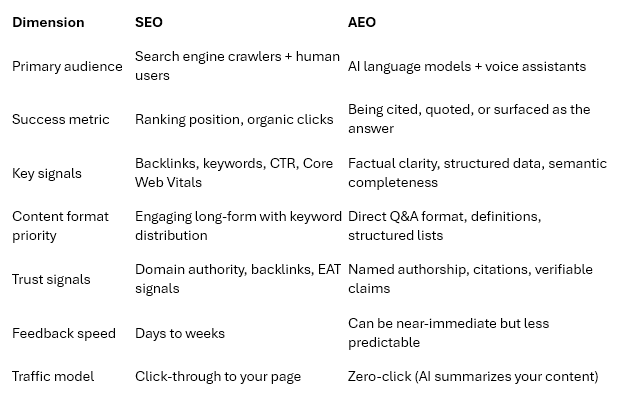
Understanding this table is critical. AEO often produces zero-click outcomes - the AI answers the user's question entirely, and they never visit your site. This means AEO success looks different from SEO success. You may gain brand authority, citations, and trust - but not necessarily direct traffic. Your content strategy must account for both.
Part 2: Ranking Factors in Depth
SEO Ranking Factors for Posts and Online Courses
Google's algorithm evaluates over 200 signals. For content creators publishing posts and course pages, the most important are the following.
Keyword Relevance and Search Intent Match
Every piece of content must be built around a primary keyword or topic cluster that real people are actively searching for. But matching keywords alone is insufficient - you must match intent. Google categorizes queries as informational (looking to learn), navigational (looking for a specific site), commercial (evaluating options), or transactional (ready to buy or enroll). A course sales page that ranks for an informational query will underperform because it serves the wrong intent; a tutorial post targeting a transactional keyword will similarly miss the mark.
E-E-A-T: Experience, Expertise, Authoritativeness, Trustworthiness
Google's quality rater guidelines place enormous weight on E-E-A-T. For posts, this means demonstrating that the author has real-world experience or credentials in the topic. For online courses, it extends to the platform's reputation, the instructor's bio, student outcomes, and verifiable testimonials. Content that lacks any signals of genuine expertise is increasingly devalued, especially in YMYL (Your Money or Your Life) niches like finance, health, and professional education.
On-Page Optimization
This includes placing the primary keyword in the title tag, H1, URL slug, meta description, and naturally throughout the body. Semantic keywords - related terms and synonyms - should appear organically. Heading hierarchy (H1, H2, H3) must be logical and meaningful, not just decorative.
Content Depth and Comprehensiveness
Google rewards content that fully covers a topic. For a post, this means addressing the question from multiple angles, anticipating follow-up questions, and providing examples. For an online course landing page, it means covering curriculum depth, learning outcomes, prerequisites, and instructor credibility. Thin content - anything that skims a topic without adding genuine insight - tends to rank poorly.
Technical SEO Fundamentals
Page speed, mobile responsiveness, secure HTTPS, clean URL structures, and proper internal linking all affect crawlability and user experience. Core Web Vitals (Largest Contentful Paint, Cumulative Layout Shift, Interaction to Next Paint) are confirmed ranking signals. A beautifully written post served on a slow, broken page will underperform.
Backlinks and Domain Authority
External links from reputable sites remain one of the strongest trust signals in SEO. Building backlinks through original research, guest posts, and linkable assets (tools, data studies, comprehensive guides) elevates both individual pages and the domain as a whole.
User Engagement Signals
Click-through rate from SERPs, time on page, and pogo-sticking (users returning to search results immediately after clicking) all signal to Google whether your content satisfies the user. A high bounce rate is not inherently bad, but a combination of high bounce rate and short session duration suggests dissatisfaction.
AEO Ranking Factors for Posts and Online Courses
AEO operates on a different logic. AI systems retrieve content through vector search or web retrieval, then decide whether it is suitable for citation. The factors that make content AEO-friendly are:
Question-Answer Alignment
AI systems are optimized to answer questions. Content that is structured as explicit question-answer pairs - with the question as a heading and the answer in the first one to three sentences below it - is far easier for AI to extract and use. Content buried in narrative prose is harder to surface.
Factual Precision and Verifiability
AI models favor claims that are specific, verifiable, and unambiguous. Vague statements like "many experts agree" are less citable than "according to a 2024 Stanford study." Named sources, dates, and statistics make your content a stronger citation candidate.
Semantic Completeness
An AI answering a question wants to give a complete answer. Content that thoroughly addresses a topic - including definitions, common misconceptions, and related subtopics - is more likely to be selected because it reduces the AI's need to synthesize from multiple sources.
Structured Data and Schema Markup
Schema markup (JSON-LD, specifically FAQPage, HowTo, Course, and Article schemas) tells AI systems and search engines exactly what type of content they're reading, who authored it, and what questions it answers. This is low-hanging fruit that dramatically improves AI discoverability.
Named Authorship and Author Credentials
AI systems increasingly try to attribute information to credible humans. A clearly identified author with a bio, credentials, and links to professional profiles (LinkedIn, academic publications, verified social accounts) makes your content more trustworthy and more citable.
Content Freshness
AI systems - especially those with web retrieval - prefer recent content. Dates, update timestamps, and content that reflects current conditions signal recency. For evergreen topics, explicitly noting when content was last reviewed or updated is important.
Concise, Direct Opening Statements
The "answer paragraph" - the first substantive paragraph after a heading - is prime real estate for AEO. If an AI is going to quote or paraphrase your content, it is most likely to pull from this location. Burying your key point in paragraph four is an AEO failure.
Part 3: Actionable Steps for Optimization
The following is a comprehensive, sequential guide for content creators. Apply these steps to every post and every online course page you publish.
Phase 1: Research and Planning
Step 1: Conduct Layered Keyword Research
Begin with a primary keyword that has meaningful search volume and matches the core intent of your content. Use tools like Ahrefs, Semrush, or Google Keyword Planner to validate volume and competition. Then build a list of semantically related terms - LSI (Latent Semantic Indexing) keywords, synonyms, and related questions. Your goal is to cover the topic cluster, not just a single phrase.
For online courses specifically, research the exact language your audience uses to describe their learning goal ("how to learn Python for data analysis" vs. "Python data science course"). These intent-specific phrases often convert better than broad terms.
Step 2: Mine "People Also Ask" and "Related Searches"
Google's People Also Ask (PAA) boxes are a goldmine for AEO. Every PAA question is a direct signal of what AI systems are being asked about your topic. Turn these questions into H2 or H3 headings in your content and answer each one directly in the paragraph immediately following. This simultaneously improves traditional SEO rankings and makes your content highly attractive to AI citation.
Step 3: Map Search Intent Precisely
Before writing a single word, confirm the dominant intent for your target keyword. Search the keyword yourself and study the top five results. Are they how-to guides? Comparison pages? Sales pages? Your content format must match the dominant intent, or you will be competing against content that Google already considers more relevant.
Step 4: Define Your Unique Angle
Content that simply rehashes the top-ranking results offers nothing new to Google or to AI systems. Identify what genuine value your content adds: original data, a proprietary framework, first-hand experience, a unique case study, or a more comprehensive treatment than anything currently available.
Phase 2: Structure and Formatting
Step 5: Craft an SEO-Optimized Title
Your title (the H1 and typically the title tag) should include your primary keyword, ideally near the beginning. It should also be compelling enough to earn a click. The title tag should be between 50 and 60 characters to avoid truncation in SERPs. Avoid clickbait - it increases CTR but damages trust and engagement signals. For course pages, include specificity: who the course is for, what they'll be able to do, and ideally a credibility marker.
Step 6: Write an Answer-First Introduction
The first 100 words of your post should answer the core question your content addresses. This serves multiple purposes: it reduces bounce rates (users immediately see they're in the right place), it satisfies Google's quality assessments, and it gives AI systems a clean, quotable answer to extract. Avoid lengthy preambles, backstory, or personal anecdotes before the answer. Those elements can come after.
Step 7: Build a Logical Heading Hierarchy
Use a single H1 (your post title). Use H2 headings for major sections. Use H3 headings for subsections within those major sections. Never skip levels. Your heading hierarchy should function as an outline - a reader who only reads the headings should understand the full scope and structure of your content.
Frame H2 and H3 headings as questions when appropriate. "What Is the Difference Between SEO and AEO?" is better for AEO than "SEO vs AEO Overview." Questions mirror how people actually query AI systems and voice assistants.
Step 8: Use Short, Scannable Paragraphs
Paragraphs should be two to four sentences long. Online readers scan before they read. Dense walls of text drive users away and make it harder for AI to extract clean, quotable information. Each paragraph should convey a single idea.
Step 9: Incorporate Tables, Lists, and Definition Blocks Strategically
Structured formats are extremely friendly to both traditional featured snippets and AI extraction. Use numbered lists for sequential processes, bulleted lists for non-sequential collections, and tables for comparisons. Definition-style blocks ("Term: definition") are particularly strong for AEO because they match the pattern AI uses to explain concepts.
For online courses, format your curriculum as a structured list with module names and learning outcomes. This is exactly the type of structured data AI systems surface when answering "what does [course name] cover?"
Step 10: Add a Dedicated FAQ Section
Near the end of your post or course page, add a Frequently Asked Questions section. Write each question as users would actually ask it - in plain, conversational language. Answer each question in two to five sentences. This section dramatically increases your chances of appearing in Google's PAA boxes and being cited by AI systems answering related queries.
Phase 3: On-Page SEO Execution
Step 11: Optimize Your URL Slug
Keep URLs short, descriptive, and keyword-rich. Use hyphens to separate words. Avoid dates in URLs for evergreen content (they signal staleness). A URL like /seo-vs-aeo-guide is better than /blog/2024/11/15/understanding-the-differences-between-seo-and-aeo-for-content-creators.
Step 12: Write a Compelling Meta Description
The meta description (150 to 160 characters) does not directly affect ranking, but it significantly affects click-through rate. Include your primary keyword, articulate the specific benefit of reading your content, and end with an implicit or explicit call to action. For course pages, mention a key outcome or differentiator.
Step 13: Optimize Images and Media
Every image should have a descriptive, keyword-relevant alt text. File names should be descriptive ("seo-vs-aeo-comparison-chart.png" not "image001.png"). Compress images to minimize load times. For video content embedded in your post or course page, add a transcript - this dramatically increases the text available for both SEO indexing and AI analysis.
Step 14: Build a Strong Internal Linking Structure
Link to your new content from existing high-authority pages on your site. Link from your new content to related posts and resources. Use descriptive anchor text - not "click here," but "learn how to conduct keyword research." Internal links distribute authority across your site and help both crawlers and AI systems understand the relationship between your content pieces.
Step 15: Optimize for Core Web Vitals
Use Google's PageSpeed Insights to check your Core Web Vitals scores. Common fixes include optimizing image formats (WebP over JPEG/PNG), eliminating render-blocking JavaScript, enabling browser caching, and using a Content Delivery Network (CDN). For course pages hosted on third-party platforms, choose platforms that prioritize performance.
Phase 4: AEO-Specific Enhancements
Step 16: Implement Schema Markup
Add structured data to your pages using JSON-LD (Google's preferred format). For blog posts, use Article schema with author, datePublished, dateModified, and publisher fields populated. For online courses, use Course schema with name, description, provider, offers, and hasCourseInstance. For FAQ content, use FAQPage schema to mark up your question-answer pairs explicitly. Use Google's Rich Results Test tool to validate your implementation.
Step 17: Establish Clear Authorship
Create a dedicated author page or bio section that includes: full name, professional credentials and experience, links to published work or professional profiles, a professional photo, and areas of expertise. Link every post back to the author page. For course pages, the instructor bio should be thorough and include verifiable credentials, past students or clients (with permission), and links to external profiles. AI systems use this information to assess whether your content comes from a credible source.
Step 18: Cite Your Sources
When you make factual claims - statistics, research findings, historical facts - link to the original source. This signals to both Google and AI systems that your content is grounded in verifiable information rather than assertion. It also makes your content more trustworthy to human readers, which improves engagement signals.
Step 19: Include a "Key Takeaways" or "Summary" Block
At the beginning or end of long-form content, add a concise summary of the main points. This is valuable for human readers who want to assess relevance before committing to a full read, and it is extremely valuable for AI systems that are deciding whether your content answers a given question. Some AI retrieval systems specifically look for summary-style content when constructing answers.
Step 20: Optimize for Voice Search and Conversational Queries
Voice queries are longer and more conversational than typed queries. A typed query might be "AEO definition"; a voice query is "What is AI Engine Optimization and how is it different from SEO?" Write sections of your content in a conversational tone that matches how someone would ask a question aloud. Answers should be self-contained - the answer to "What is AEO?" should make complete sense without context from surrounding paragraphs, because a voice assistant will read only that excerpt aloud.
Phase 5: Authority and Trust Building
Step 21: Pursue Strategic Backlinks
Backlinks remain the highest-weight signal in traditional SEO. For posts, earn links by producing original research, comprehensive guides, useful tools, and data-driven content that others in your niche naturally want to reference. For course pages, pursue backlinks through partnerships with industry publications, guest interviews, and course review sites. Even a handful of high-quality backlinks from authoritative domains has outsized impact.
Step 22: Build Topical Authority Through Content Clustering
Google and AI systems both assess the breadth and depth of your expertise on a topic. A single great post is not enough. Build a content cluster: a comprehensive pillar page covering the broad topic, supported by multiple supporting posts that go deep on specific subtopics, all interlinked. This signals to Google that your site is a genuine authority on the subject, and it gives AI systems a rich body of content to draw from when answering related questions.
Step 23: Keep Content Fresh
Update posts periodically to reflect new developments, correct outdated statistics, and add new sections. When you update, change the dateModified value in your schema markup. Add a visible "Last Updated" note near the top of the post. Fresh content performs better in traditional search and is preferred by AI systems with web retrieval capabilities.
Step 24: Earn Reviews and Social Proof for Course Pages
For online courses, user-generated content like reviews, testimonials, and ratings serve as trust signals for both SEO (review schema can enable star ratings in SERPs) and for human decision-making. Encourage students to leave detailed, specific reviews. A course page with 50 detailed reviews describing specific outcomes is far more compelling - to Google, to AI systems, and to prospective students - than a page with no social proof.
Step 25: Monitor, Measure, and Iterate
SEO and AEO are not set-and-forget disciplines. Use Google Search Console to track impressions, clicks, and average position for each page. Use analytics to monitor on-page behavior. For AEO, manually track whether your content is being cited by AI platforms - search your topic in ChatGPT, Perplexity, and Google AI Overviews, and note which sources they cite. If competitors are being cited instead of you, analyze why: their structure may be clearer, their authority signals stronger, or their content more comprehensive.
Quick-Reference Checklist
Before publishing any post or course page, verify the following:
SEO Checklist
Primary keyword appears in H1, URL, title tag, and meta description
Heading hierarchy (H1 → H2 → H3) is logical and complete
Content fully covers the topic and matches search intent
Images have descriptive alt text and are compressed
Page loads in under 3 seconds on mobile
Internal links point to and from the page
Author name and bio are visible
AEO Checklist
Introduction provides a direct, concise answer in the first 100 words
Key H2 or H3 headings are phrased as questions
At least one FAQ section is present with conversational Q&A pairs
Article, Course, or FAQ Page schema markup is implemented and validated
All factual claims are linked to primary sources
Author has a detailed bio with verifiable credentials
A "Key Takeaways" or summary block is present
Content is dated and shows a "Last Updated" timestamp
Conclusion
The rise of AI-powered search does not make traditional SEO obsolete - it raises the stakes. Content that was mediocre but keyword-stuffed can no longer slide by. The dual demands of SEO and AEO require content that is genuinely excellent: deeply researched, clearly structured, factually grounded, and authored by identifiable experts.
For content creators publishing posts and online courses, this is ultimately good news.
The optimization techniques that win in an AI-driven search landscape - clarity, expertise, comprehensive coverage, honest attribution - are the same principles that create content worth reading in the first place. Optimize for humans and machines simultaneously by committing to quality, and both will reward you.
Start with the fundamentals: answer a real question, answer it well, structure it so a machine can read it and a human can trust it. The rest follows from there.

by Martyn Brown …
The business side of Martyn Brown’s online career didn’t come until the late 1990s when affiliate marketing was the name of the game along with newsletters via email.
After running several offline magazines for home businesses, Martyn launched a major local community magazine. This ran for around seven years and also won a national award for Best Local Magazine in the UK.
Then a new local community magazine for his local area was launched which, eventually, led to the main online business that is still being run today, namely, Marketing Bugle.


Created by Marketing Bugle © Martyn Brown